

AI Receptionist for Healthcare Practices: Trends, Benefits and What Practices Should Know
AI Receptionist for Healthcare Practices: Trends, Benefits and What Practices Should Know
Healthcare practices have a communication problem that technology alone cannot solve—but the right technology can make it considerably easier to manage.
Patients call to schedule appointments, ask about office hours, confirm visits, request directions, check the status of routine requests, and reschedule appointments. At the same time, front-office employees are handling patients in the office, insurance information, referrals, authorizations, documentation, and numerous other administrative responsibilities.
This is where the healthcare AI receptionist is emerging as an important industry trend.
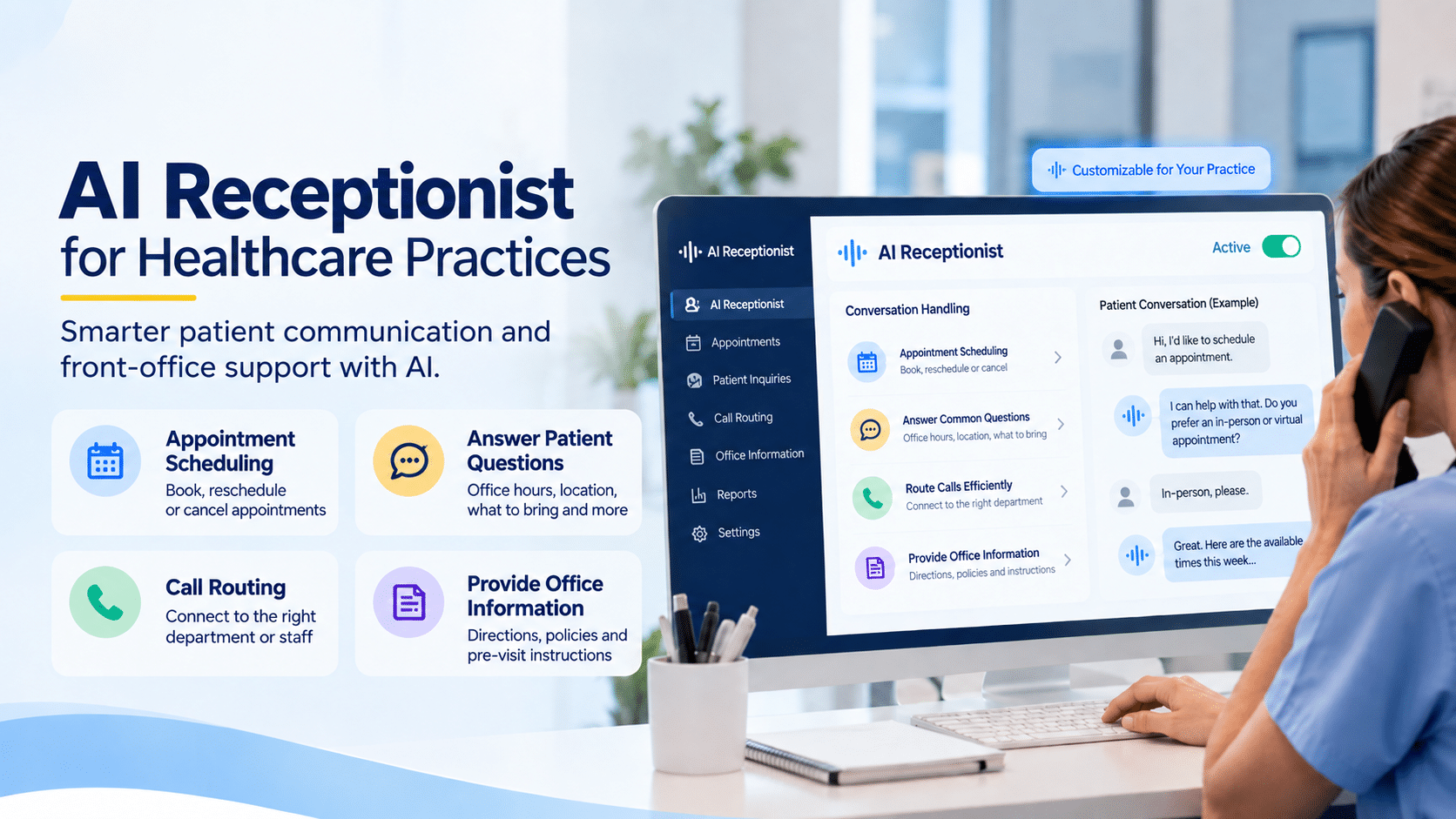
An AI receptionist is software designed to use artificial intelligence, automation, and conversational technology to handle selected patient communication and administrative tasks. Depending on the system and configuration, it may assist with routine inquiries, appointment-related requests, call routing, and other repetitive front-office interactions.
In healthcare, an AI receptionist should not be viewed simply as a replacement for front-office employees. A more useful model is a digital front-door assistant that handles appropriate routine interactions while escalating clinical, sensitive, complicated, or unusual situations to qualified staff.
For specialty practices—including sleep medicine—this combination of automation and human support may become increasingly important as practices look for ways to improve patient access without creating additional administrative work.
What Is an AI Receptionist in Healthcare?
A healthcare AI receptionist is a conversational system designed to automate selected front-office communications through technologies such as natural language processing, voice AI, workflow automation, and integrations with practice-management systems.
Depending on its capabilities, an AI receptionist may help a practice:
- Answer common non-clinical questions.
- Route calls or requests to the appropriate department.
- Assist with appointment-related interactions.
- Provide office information and instructions.
- Collect predefined information from patients.
- Handle selected communications outside normal office hours.
- Escalate interactions requiring human assistance.
The goal should not be to make healthcare communication less human.
The goal is to use automation for interactions that can safely and appropriately be automated so staff have more time for conversations that genuinely require human attention.
Why Are Healthcare Practices Exploring AI Receptionists?
A traditional medical office phone workflow depends heavily on staff availability.
When employees are assisting patients, working on referrals, completing insurance-related tasks, or communicating with providers, incoming calls can compete for the same limited attention.
An AI-assisted communication layer potentially gives practices another way to manage routine demand.
Instead of requiring staff to manually respond to every basic interaction, appropriate requests can potentially be handled or triaged automatically.
For practices evaluating this technology, the most relevant question therefore isn’t:
“Can AI answer our phones?”
It is:
“Which patient interactions can be safely automated, and which ones should always reach a person?”
That distinction is particularly important in healthcare.
How Could an AI Receptionist Help a Medical Practice?
1. Handle routine patient questions
Many incoming questions are predictable.
Patients may want to know office hours, location information, what they need to bring to an appointment, or how to complete a routine administrative step.
When properly configured, AI may be able to answer defined questions consistently while allowing staff to concentrate on more complex requests.
2. Support appointment workflows
Scheduling is one of the most obvious areas where conversational technology and workflow automation can intersect.
A patient might need to:
- Request an appointment.
- Find an available time.
- Confirm an appointment.
- Reschedule.
- Cancel.
- Receive instructions about the next administrative step.
When scheduling functionality is connected appropriately, digital patient access can extend beyond the traditional phone queue.
3. Extend access beyond office hours
Patients do not necessarily think about scheduling during a practice’s business hours.
They may remember to make an appointment at night, during lunch, or on a weekend.
Digital scheduling and conversational tools can provide an additional access channel when staff are unavailable.
That does not mean every interaction should be resolved automatically. Rather, the system can capture or appropriately handle supported requests and direct exceptions to staff.
4. Route requests more efficiently
A significant part of reception work involves figuring out where a request belongs.
Is it scheduling?
Billing?
A referral question?
A prescription request?
A clinical question?
AI-assisted routing may help classify routine requests so the right staff member receives them sooner.
5. Give staff more time for higher-value interactions
The strongest case for healthcare automation is not simply “fewer people.”
It is better use of people’s time.
A patient who is anxious about a diagnosis, confused about treatment, having difficulty with insurance, or reporting a clinical problem needs a different experience from someone asking for office hours.
Technology can help distinguish between those interactions—but the practice must design appropriate escalation paths.
AI Receptionists and Sleep Medicine
Sleep medicine presents an especially interesting environment for patient communication automation because the patient journey can involve several steps.
Depending on the patient’s condition and the services provided, the journey might include:
Referral → Consultation → Eligibility/Authorization → Sleep Study → Diagnosis → Therapy → DME → Follow-Up → PAP Compliance
Each stage can generate administrative communication.
A sleep practice or sleep lab may need to coordinate appointments, patient instructions, studies, documentation, equipment, follow-up, and ongoing therapy-related workflows.
That makes integration especially important.
A stand-alone AI phone system that does not understand the practice workflow can simply create another disconnected technology layer.
The larger opportunity is a connected digital workflow in which patient communication, scheduling, documentation, patient information, and operational systems can work together.
AI Is Already Becoming Part of Sleep Medicine
AI in sleep medicine extends far beyond reception.
The American Academy of Sleep Medicine has been actively examining AI’s role in the specialty. Its AI resources address responsible clinical integration, AI-enabled technology, sleep-study applications, and other potential clinical and operational uses.
The AASM has also emphasized that AI can potentially augment clinical operations and patient-centered sleep care rather than simply functioning as an autonomous replacement for clinicians.
That principle is equally useful when thinking about administrative AI.
The best healthcare AI should augment people—not remove appropriate human judgment from the workflow.
Where Should Human Staff Stay Involved?
Healthcare organizations should establish clear boundaries around automation.
Situations that may require human intervention include:
Clinical questions
An AI receptionist should not independently diagnose symptoms or make clinical decisions unless a specific regulated and clinically governed system is explicitly designed for that purpose.
Emergencies
Systems should clearly identify emergency-related language and direct patients to appropriate emergency resources rather than attempting to manage urgent medical situations as routine administrative conversations.
Complex insurance and authorization problems
Insurance workflows often contain exceptions. Patients may require staff assistance when eligibility, coverage, referrals, or authorization information is unclear.
Sensitive patient concerns
Patients sometimes need empathy, judgment, flexibility, and context. Automation should make it easy—not difficult—to reach a person.
Unusual requests
No automated system can anticipate every possible interaction. Reliable escalation is therefore essential.
What Should Practices Look for in Healthcare AI Receptionist Technology?
Before implementing an AI receptionist, practices should evaluate more than voice quality.
Healthcare workflow integration
Can the system interact appropriately with scheduling and practice workflows, or does it simply create messages for staff to process later?
Privacy and security
Healthcare organizations need to evaluate how patient information is collected, transmitted, stored, accessed, and protected.
Human escalation
Patients should have a clear route to a person when the automated workflow cannot appropriately address the situation.
Configurability
A cardiology office, primary care clinic, sleep medicine practice, and DME workflow do not operate identically.
Healthcare AI needs workflow-specific configuration.
Accuracy and monitoring
Practices should routinely evaluate what the AI says and does.
AI output should not be assumed to be correct simply because it sounds confident.
Transparency
Patients should understand when they are interacting with an automated system where appropriate.
The Bigger Trend: From Isolated Automation to Connected Workflows
AI receptionists are part of a broader movement in healthcare technology.
Practices are increasingly looking at the entire patient journey rather than implementing isolated tools.
For a sleep medicine organization, that could mean connecting:
Patient inquiry → Scheduling → Intake → Eligibility → Authorization → Visit → Sleep Study → Documentation → Treatment → DME → Follow-Up
This is where an integrated EHR and practice-management environment becomes important.
1st Providers Choice offers specialty-focused healthcare technology, including solutions designed around Sleep Medicine workflows. Its Sleep Medicine EHR capabilities include tools supporting areas such as sleep patient process management, patient self-booking, appointment reminders, eligibility and authorization workflows, sleep-specific documentation, DME management, PAP compliance, patient portals, and related practice operations.
An AI receptionist should be considered within that larger workflow—not as an isolated technology purchase.
AI Should Make Healthcare More Accessible, Not More Frustrating
Poorly designed automation creates barriers.
Good automation removes them.
Healthcare practices evaluating AI should therefore measure success from both sides of the conversation.
For the practice:
- Did routine administrative work become easier?
- Were requests routed correctly?
- Did employees spend less time on repetitive interactions?
- Could staff focus more attention on patients needing assistance?
For the patient:
- Was it easy to get help?
- Could they reach a person when necessary?
- Was the information accurate?
- Did the technology make access simpler?
Those questions matter more than whether a practice can say it “uses AI.”
The Future of the Healthcare Front Desk Is Likely Hybrid
The future front desk may not be entirely human or entirely automated.
It is more likely to be human + digital + AI-assisted.
Routine transactions can increasingly move through digital channels, while employees remain available for complex, sensitive, clinical, and relationship-based interactions.
For sleep medicine practices, this model can be particularly valuable because patient care frequently extends across multiple administrative and clinical stages.
The goal is not automation for automation’s sake.
It is creating a more connected patient experience while giving practice teams technology that supports—not complicates—their work.
Frequently Asked Questions
What is an AI receptionist for healthcare?
An AI receptionist is software that uses conversational AI and automation to handle selected patient-facing administrative interactions, such as routine questions, appointment-related requests, routing, and information collection. Capabilities vary significantly between systems.
Can an AI receptionist replace medical office staff?
AI can automate selected repetitive interactions, but healthcare practices still need human involvement for complex, sensitive, clinical, and exception-based situations. A hybrid model is generally more appropriate than treating AI as a universal staff replacement.
Is an AI receptionist the same as a chatbot?
Not necessarily. A chatbot is generally a text-based conversational interface. An AI receptionist may operate through voice, text, or multiple communication channels and may connect with scheduling and other practice workflows.
Can AI be used in sleep medicine?
Yes. AI is being investigated and used across multiple areas of sleep medicine. The American Academy of Sleep Medicine has published resources addressing responsible AI integration and potential clinical and operational applications.
What should a medical practice consider before implementing AI?
Practices should evaluate privacy, security, accuracy, integration, patient experience, human escalation, workflow configuration, monitoring, and the specific tasks the system is permitted to perform.
Build a More Connected Practice Workflow
AI is changing healthcare, but successful practice transformation requires more than adding an AI tool.
Scheduling, patient intake, insurance workflows, documentation, communication, EHR functionality, and follow-up should work as a connected system.
Discover how 1st Providers Choice can help your practice build a more connected healthcare workflow.
Schedule a demo with 1st Providers Choice.